Eastern Hokkaido Without a Car: 5-Day Train Itinerary

Many people skip Eastern Hokkaido saying “Oh I don’t drive. And public transportation there looks inconvenient”.
Sure, it’s not like Tokyo or Sapporo. You need to plan your trip carefully around the time table, because the trains in the countryside don’t run every 2 minutes.
But what if I tell you that I had one of my best Hokkaido trips recently using local trains?
Hi, I’m Yuuka. I grew up in Eastern Hokkaido, and I’ve spent years helping international travelers plan trips here.
I did this trip over 5 days, starting in Sapporo and traveling to Kushiro, Toro, Kawayu Onsen, and Abashiri. I had some of the freshest locally caught seafood, walked nature trails in two national parks, stayed in an onsen town, and met lovely local guides and shop owners along the way.
If this sounds like your type of trip, here’s how I traveled around Eastern Hokkaido without a car, and how you can follow the same route.
This post is sponsored by Hokkaido Air System (HAC) and Trippino, who covered my travel costs.
The itinerary overview

I did this trip in early August, but some days were quite hot. If you want to walk the same long trails I did, I’d recommend June, September, or October for cooler temperatures.
If long trails aren’t your thing, don’t worry. I’ll show you a shorter alternative for each walking day.
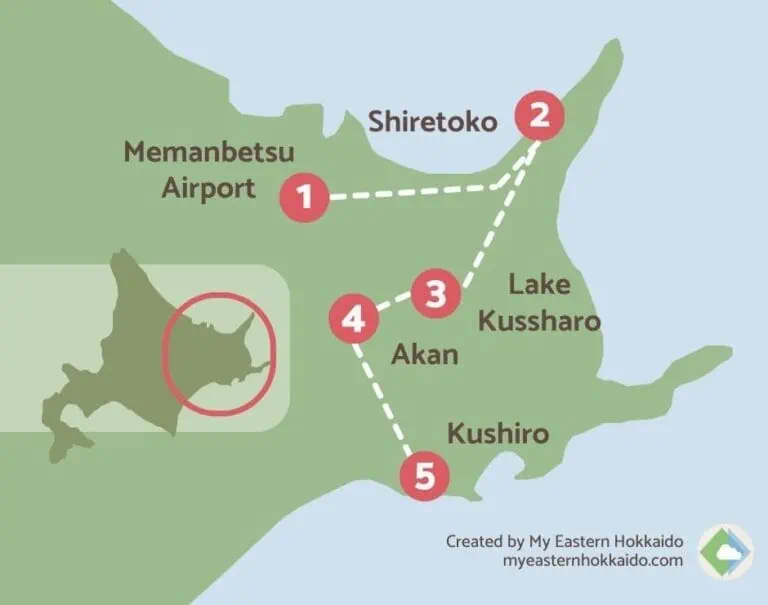
- Day 1: Fly from Sapporo to Kushiro, then watch the sunset at Nusamai Bridge and eat charcoal-grilled seafood
- Day 2: Train to Toya, then walk 12 km (7.5 miles) of the Hokkaido East Trail to Hosooka Observatory in Kushiro Shitsugen National Park (about 4 hours), then on to Toro, my favorite spot of this trip
- Day 3: Train to Biruwa, then walk 15 km (9.3 miles) of the Hokkaido East Trail through Akan-Mashu National Park (about 5 hours), passing an active volcano on your way into Kawayu Onsen town
- Day 4: Train to Abashiri for local museums, a glass workshop, and a cafe
- Day 5: Bus to Memanbetsu Airport, then fly back to Sapporo
How to go to Eastern Hokkaido from Sapporo

Many travelers ask me this question, and my answer is always the same. Take a flight. It’s just 50 minutes!
Yes, you could drive or take the train from Sapporo all the way out east, but that’s 4–5 hours and a lot of your energy.
I’d rather spend that time exploring. If you agree with me, here’s the airport I use.
Use Sapporo Okadama Airport

Did you know New Chitose isn’t your only choice if you’re flying out of Sapporo?
There’s Sapporo Okadama Airport right inside the city, only about 30 minutes from Sapporo Station.
It’s a small local airport that not many international travelers know about. But it connects Sapporo to other airports across Hokkaido, including Memanbetsu, Kushiro, and Nakashibetsu in the east. Flights run a few times a day, operated by the regional airline Hokkaido Air System (HAC).

I like using Sapporo Okadama Airport because New Chitose has gotten so crowded with tourists lately, and honestly I find it overwhelming.
Getting there from Sapporo Station

The easiest way is to take the direct bus. It’s 1,000 JPY (about US$7), runs 10 times a day, and takes 30 minutes.
Or you can take the Toho subway line to Sakaemachi Station (16 mins), then change to a local bus (5 mins). It’s 490 JPY in total.

If you have large suitcases, I’d recommend taking the direct bus. The walk to the subway platform is long, and the local bus is an ordinary city bus with no luggage hold underneath.
How much does the flight cost?
Fares range from about 7,700 to 25,000 JPY (roughly US$50toUS$165) depending on the season.
Sure, flying might cost more than taking the train or driving, but you’ll get to do more. If you take the first flight in the morning, you’ll arrive before noon and still have most of the day ahead of you.
Day 1: Sapporo to Kushiro
Day 1 is an easy one. Depending on your flight, you’ll have an afternoon or most of the day in Kushiro.
I kept mine simple with a walk down to the port, sunset at Nusamai Bridge, and Kushiro’s famous charcoal-grilled seafood for dinner. A gentle start before the two walking days ahead!
Getting to Kushiro

I took the 2:10 PM flight from Sapporo Okadama Airport to Kushiro, arriving at 2:55 PM. I had lunch inside Okadama Airport before boarding, and probably the best view I’ve ever had with curry rice!

At Kushiro Airport, a bus to the city center leaves about 15 to 20 minutes after every flight arrival. It’s 1,200 JPY (about US$8), takes around 40 minutes, and you buy your ticket from the machine before boarding. It’s cash only here.
I flew on a Wednesday afternoon and neither the flight nor the bus was crowded.
Where I stayed in Kushiro: Hotel Route Inn


I stayed at Hotel Route Inn Kushiro Ekimae, a simple business hotel. I chose here because of the location. It’s right across from the bus stop and the station.
There’s a small public bath in the basement. It’s not an onsen, but after a travel day it does the job! There are also washing machines (200 JPY) and dryers (100 JPY). You can buy a detergent at the reception for 50 JPY.
Local products & sunset

About 15 minutes walk from the hotel, you’ll arrive at Fisherman’s Wharf MOO, a riverside complex. The first floor has several Hokkaido souvenir shops and I picked up a few things there.
The second floor is a row of izakaya, but don’t stop to eat here. I’ll show you a better dinner spot in a bit.
Outside of the building, there’s the city’s symbol, Nusamai Bridge. Kushiro is known for one of the most beautiful sunsets in Japan, and this bridge is the most popular place to watch it.

I arrived about 30 minutes before sunset, but there were already plenty of people waiting! You’ll see the sun go down in the port, which is beautiful, but if you don’t like the crowds, just pass by to get a glimpse around the sunset time and that’ll be enough.
Dinner: Robata, grilled seafood

Robata is the Kushiro specialty. It’s fresh seafood, grilled over charcoal right in front of you.
Many of the robata restaurants are on the station side of the bridge, near MOO, but I found a nice cozy place on the other side, Robata Hamabanya.

I ordered oysters, Tsubugai whelk, and Komai (saffron cod), Hokkai shrimp, onigiri. Since I was traveling solo, I couldn’t order any large seafood dishes, but I’d recommend the Hokke (Atka mackerel) or crab if you’re with 2 or more people.
They have an English menu, and the auntie there spoke some English. She told me they welcome international travelers, so save this place if you’re planning to visit Kushiro!
Day 2: Kushiro Wetland Trail & Toro

The next two days are an adventure. I walked a section of the Hokkaido East Trail each day, and it was absolutely the highlight of my trip!
The two trails I did were mostly flat and easy, but they take about 4–5 hours each, so you need to be fit enough to walk the distance.
Not into walking trails? No worries, I’ll show you some great alternatives for non-hikers!
What’s the Hokkaido East Trail?
The Hokkaido East Trail is a massive 410-km (255-mile) long trail that runs across Eastern Hokkaido, from Kushiro all the way to Rausu in Shiretoko.
It connects three national parks (Kushiro Shitsugen, Akan-Mashu, and Shiretoko) allowing you to see wetlands, pastures, calderas, farmlands, the ocean, and all the small towns in between.
I got to walk only short sections of it this time, but I’d love to come back and complete the whole trail one day! You can find out more details and route maps on their official website.
Breakfast at Washo Seafood Market

My hotel included breakfast, but I skipped it. Because Kushiro’s famous Washo Seafood Market was just a 3-minute walk away.
I went in as soon as it opened at 8 am and made my own Kaisendon (seafood rice bowl) for breakfast. First you buy a bowl of rice from one of the rice shops. Then you walk to the sashimi stalls and pick whatever you want and make a bowl to your taste!

Mine was 3,045 JPY (rice bowl 400 JPY, sashimi 2,475 JPY, crab miso soup 170 JPY). There’s seafood from all over Hokkaido and also caught locally in Kushiro.

If you need to stock up on water or snacks before hitting the trail, There’s a Seicomart convenience store right next door.
Getting to Toya

Take the 8:47 AM train from Kushiro on the JR Senmo Line bound for Abashiri. You arrive at Toya at 8:59 AM, and the fare is 360 JPY (about US$2.40).
At Kushiro Station, make sure to
- Use the bathroom, and
- Buy tickets for the rest of your trip.
Most of the stations in this itinerary are small unstaffed stations without ticketing machines. You could pay the fares inside the train, but since they accept only cash, it’s easier to buy tickets in advance at Kushiro Station.
If you’ve ever taken trains in Tokyo, you might be surprised by the size of the trains on this line. They are just a single car, due to a shrinking local population and fewer daily commuters along the route.
Kushiro Wetland Trail

The trail starts right at Toya Station. This section runs 12 km (7.5 miles) and takes about 4 hours.
There’s no big elevation change. It’s a walking trail rather than a hike. You’ll pass through the town of Toya first, then join a long forest road that runs along the edge of the Kushiro wetland, which used to be the ocean around 6,000 years ago.

We got lucky and saw a Tancho red-crowned crane! This area is home to the rare Tancho cranes that almost disappeared about 100 years ago, due to land development and hunting. However, in 1924, a local farmer found a small group of survivors. People in the area started protecting them, and now the population is back over 1,900. If you find one, that’s the result of 100 years of local people’s effort looking after them.
Note: This section isn’t marked. You need the map, and you need to keep checking it to make sure you’re staying on the right path.
The official route and map are here.
Walking with a guide

In Hokkaido, hiking comes with a risk of encountering brown bears. So please always take precautions to avoid bears.
To mitigate the risks, I walked with Noriko-san and her husband Jun-san, who both work as local nature guides.
They didn’t only ensure safety, but also explained the history of the land and the seasonal plants growing along the trail. I learned so much that I wouldn’t have known otherwise.
Noriko-san, who’s born and raised in Kushiro, guides in English as well. If you’re looking for a nature or mountain guide around Kushiro, check out their website here.
Hosooka Observatory

The trail finishes at Hosooka Observatory, inside Kushiro Shitsugen National Park.
From here, you can see the vast wetland, and even deer or cranes if you have binoculars with you.
There are several observation points around the national park, but Noriko-san says this is the best of them because you can look out over the Kushiro River meandering across a huge open marsh.
There’s a visitor’s lounge nearby with restrooms, a small souvenir shop, and couches to sit down (perfect after the long walk!).

I loved Imo Mochi here, Hokkaido’s classic snack potato mochi.
Rest here until your train. Kushiro Shitsugen Station is about a 5-minute walk away.
Alternative to the trail
If you’d rather skip the long walk, just take the train from Kushiro directly to Toro.
That means skipping Hosooka Observatory too, but there’s currently no convenient connection that lets you stop there and continue on to Toro, since trains run so infrequently you’d be waiting hours for the next one.
Once you arrive in Toro, you can enjoy an easy walk along Lake Toro.
Train to Toro

Kushiro Shitsugen Station is also unstaffed with no ticket machine. Make sure to buy your ticket at Kushiro Station in the morning.
I hopped on the 2:33 PM train bound for Abashiri, arriving in Toro at 2:45 PM*. The tracks run right alongside the edge of the wetland, offering fantastic views. If you’re lucky, you might spot red-crowned cranes or Ezo deer from your window!
*Note: For this leg, I rode the Kushiro Shitsugen Norokko, a special sightseeing train that is sadly retiring in 2026. Be sure to double-check the latest JR Hokkaido timetables when planning your trip.
Things to do in Toro
Even growing up in Eastern Hokkaido, I had never heard of Toro until I planned this trip. But this was my favorite area on the trip!

Bobs’ Burger is right across from the station, and I had a late lunch there. The burger came loaded with crisp lettuce, and the house sauce was delicious. The fries were good too.

Tuna-Kai, a handmade crayon workshop, is next door and it’s a lovely shop with a heartwarming story.
The owner Tomoko-san once met a boy with allergies who couldn’t use store-bought crayons or paints. He had never drawn anything. She wanted him to be able to draw freely and promised to make crayons that he could use.
So she started making crayons using plants and natural materials she gathered from around her place and across Hokkaido. About 10 years of trial and error later, these ones came into life!
The shop is full of handmade goods beyond the crayons. She doesn’t speak English much, but she’s such a warm and charming lady. Please say hello if you stop by!

Nitai To Shibecha Museum is about a 15-minute walk from there.
It’s a small museum on the edge of a small town, and it’s a surprisingly well-curated gem! You can learn about the history of Shibecha Town, Ainu culture, and the wildlife living around here.
Download the Uni Voice app and you get a multilingual audio guide. Admission was 220 JPY (about US$1.50), and keep in mind that it closes at 4:30 PM. That was tight when I did this day, so keep an eye on the time!
Where I stayed in Toro: THE GEEK


After the museum, I headed to THE GEEK, a cozy guesthouse near Toro Station.
The owner, Keisuke-san, fell in love with the area and started the guesthouse here 7 years ago. I absolutely loved the warm, stylish interior and the room on the wetland side. I got to watch Ezo deer grazing from the window!
Since there are no restaurants or convenience stores nearby that are open in the evening or early morning, you’ll want to book a stay with dinner and breakfast included. And the food was my favorite part of the stay.


Keisuke-san loves to cook with Hokkaido ingredients. For dinner, I had a delicious pasta with Hokkaido tsubugai whelk and an apple pie made by his mother for dessert.
He studied abroad and speaks fluent English, so you can enjoy a friendly chat over the kitchen counter.
Day 3: Volcano & Forest Trail and Kawayu Onsen

Welcome to the second walking day! It’s a bit longer than the first, but there are so many fun places to stop along the way.
Once again, I walked with a local guide, Yukiko-san from the Teshikaga Trail Club. Since she is also in charge of the regular maintenance for this trail, she literally knows it all! I learned so much about the area from her, and most of the fun facts I share below are things she taught me.
If you aren’t up for a long walk, don’t worry, I’ll also give you an easier alternative.
Getting to Biruwa Station

After fueling up with breakfast, I took the 9:26 AM train from Toro, arriving at Biruwa at 10:20 AM. The fare was 1,380 JPY (about US$9).
Biruwa is another tiny, unstaffed station, but it has so much charm! The cute illustrations on the outside walls were drawn by students from the nearby Biruwa Elementary School.
The stained glass inside was made by students at Teshikaga Junior High School as part of an art class project. Their theme was to create something that would “warm up” the people who use this station.
Sadly, this station is on a list of candidates for closure because so few people use it. Many small stations across Eastern Hokkaido are facing the same challenge. I really hope that more travelers using these rural stations can help keep them alive.
Volcano & Forest Trail

This section runs 15 km (9.3 miles), taking about 5 hours.
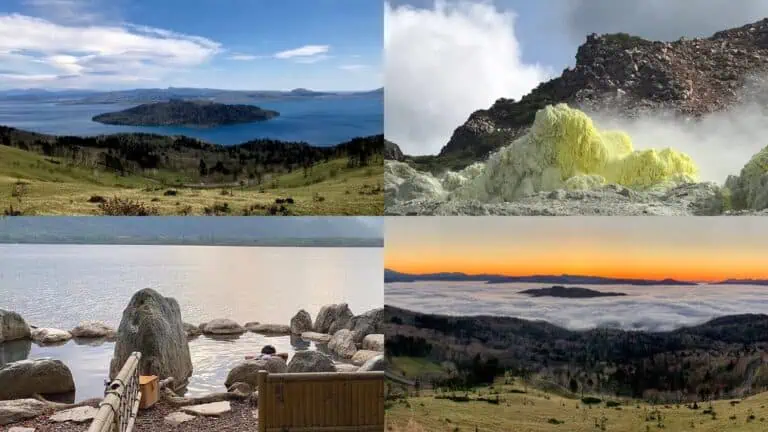
The terrain keeps changing and offers so much to see! First, you’ll walk on the road alongside farmlands before heading into a quiet forest road covered in ferns. Here, you’ll pass the ruins of the old Kushiro Railway, which gives you a glimpse into the area’s sulfur mining history. As you exit the forest, you’ll catch sight of the active volcano, Mount Io before making your final stretch toward Kawayu Onsen town.
You can find the official route here.
Biruwa Spring Water

Just a few minutes from Biruwa Station, you’ll find a small spot where you can get fresh spring water sourced directly from underground Lake Mashu. It’s actually one of only two places where you can collect this water! Be sure to fill your bottle here before your walk. It’s cold and so refreshing!
Lunch at Kawayu Onsen Station


About 2/3 of the way along the trail, you’ll reach Kawayu Onsen Station, another small, unstaffed station. It has a free footbath and a spot to fill up your water bottle.
We had lunch at Orchard Grass, a charming restaurant inside the station building. It was converted from the old stationmaster’s office back when the station still had staff. I absolutely loved the retro vibe and it shows a taste of the town’s lively golden days.


I ordered the hamburg steak lunch, which came in a very generous portion! It was exactly what I needed to keep going for the rest of the trail.
They also sell delicious cakes baked by the owner’s wife. People literally travel for hours from other towns just to buy them! If you have any room left in your stomach, you definitely need to try one.
Mount Io

About 30 minutes from the station, you’ll arrive at Mount Io. “Io” means sulfur in Japanese. This mountain once boomed with sulfur mining, which brought the railway to the area and helped develop the nearby Kawayu Onsen. Today, it’s a popular tourist spot and one of the rare active volcanoes in Japan where you can safely get close to the steaming vents.
There’s a rest house at the mountain called MOKMOK Base selling souvenirs and soft serve ice cream. But my favorite here is the boiled eggs! They are steamed in hot spring water heated by the mountain, giving them a faint sulfur aroma and a unique flavor you won’t find anywhere else.
The stretch from Mount Io down into Kawayu Onsen is a fascinating walk because of all the different plants growing there. The sulfur from the mountain makes the soil poor and the conditions incredibly harsh.

Because of this, the plants that survive here are actually alpine species, but growing at a much lower elevation than you’d normally ever find them. You literally see the trees and ground cover change as you walk further from the mountain!
Kawayu Visitor Center

The trail ends at the Kawayu Visitor Center in Kawayu Onsen Town. It’s a great spot to learn about how Lake Kussharo was formed and discover the local plants and wildlife of the area.

On the second floor there’s a lovely cafe looking out over the pure Sakhalin spruce forest next door. You can grab a coffee to recharge, but you’re also completely welcome to just sit and rest your legs without buying anything!
Alternative to the trail
If a 15 km walk sounds a bit too much for you, don’t worry. You can simply stay on the train until Kawayu Onsen Station and walk to the onsen town from there. This shorter route takes about 2 hours, including time for a break at Mount Io.
Where I stayed in Kawayu Onsen: Suikazura

This is where I always stay when I come to Kawayu Onsen. Suikazura is about a 5-minute walk from the visitor center.
It’s a nice, mid-range onsen hotel. The baths aren’t huge, but the water quality is excellent. It’s 100% free-flowing natural hot spring water sourced directly from Mount Io, meaning you get to fully experience the rich minerals and authentic sulfur scent!


Right next to the hotel is the Kawayu Ganban Terrace. A river of natural hot spring water flows down from Mount Io here, and you can walk right alongside it. The illuminations at night are beautiful too. Just be careful if you decide to touch the river. It’s actually really hot!
Izakaya Dinner in Kawayu Onsen

You can easily eat at the hotel buffet, but I decided to head to an izakaya in town this time.
Inakaya Genpei is a small, cozy izakaya serving a wide variety of local Hokkaido dishes. I ordered their signature potato croquettes, grilled pork skewers, butter-sautéed shiitake mushrooms, grilled tsubugai (whelk), and onigiri. I loved every single dish.
One thing to note is that they don’t take reservations. If you want to make sure you get a seat, go right at their opening time at 6:00 PM.
Day 4: Abashiri
After two full days on the trails, Day 4 is all about taking it easy! Today is mostly a scenic travel day, ending with a relaxed afternoon exploring a couple of local museums and a cafe in the coastal town of Abashiri.
Morning Sweets at Fugetsudo

After breakfast and checking out, I had some time before my bus, so I headed to Fugetsudo, a historic sweet shop that’s been around for over 50 years. I had actually tried their cute bear-shaped monaka (a traditional Japanese sweet made of crispy wafers filled with red bean paste) at another shop the other day and absolutely loved it, so I knew I had to visit their original main store!
Since opening in 1973, it has been run by a sweet elderly couple. It’s the only pastry shop in the onsen town. It’s so impressive that they bake shelves full of cakes and sweets just by themselves!


I picked up a lovely chocolate cake decorated with a tanuki (raccoon dog) face and another bear monaka. They have a small eat-in space inside, so I enjoyed my cake there while having a chat with the grandma.
Getting to Abashiri

The bus departs from the Taiho Sumo Memorial Hall stop, which is just a 3-minute walk from the hotel, at 10:00 AM on the Akan Bus Kawayu line, arriving at Kawayu Onsen Station at 10:12 AM. The fare is just 300 JPY (about US$2).
From there, you’ll take the 10:29 AM train, which gets you into Abashiri at 11:59 AM for 2,020 JPY (about US$13). It’s a nice 1.5-hour ride where you get to look out over endless potato fields before the view opens up to the beautiful Okhotsk coastline!
Quick Lunch: Crab Rice Bento

Once you arrive at Abashiri Station, you’ll have about 45 minutes before the sightseeing loop bus departs at 12:44 PM. I highly recommend taking this bus!
Since I had booked the Hotel Route Inn Abashiri Ekimae for the night, I went to drop off my suitcase first.

For a quick lunch, I grabbed a delicious crab rice bento made by Moriya Shoten, a long-standing local shop, and ate it inside the station. Alternatively, you could have Gyudon at Sukiya, a beef rice bowl chain next to the station. The bus stop is located right in front of it, so you won’t have to rush at all!
Getting around Abashiri
Abashiri has many tourist spots, and compared to other small towns in the region, it’s actually easy to get around without a car. There are two main ways to travel:

The Sightseeing Facility Loop Bus
This bus makes 4 round trips a day, running from Abashiri Station up to the three museums on Mount Tento (280–420 JPY per ride from the station). If the bus schedule doesn’t line up with your plans, I recommend using the option below.

Doko Bus (On-Demand Bus)
This is a reservation-only shared shuttle bus that costs either 500 or 700 JPY per person per ride, depending on the zone. It’s very convenient if the regular loop bus isn’t running when you need to move, or if you want to visit somewhere outside the standard bus route. Doko Bus has stops all over the city, including major tourist attractions.
Just note that they only accept same-day reservations, and the service finishes at 4:00 PM. Be sure to check the details on their official website.
You can purchase a day pass that covers both the loop bus and Doko Bus here: Okhonavi
Museum of Northern Peoples

Catching the 12:44 PM loop bus from Abashiri Station, my first stop was the Hokkaido Museum of Northern Peoples, arriving just before 1:00 PM.
This museum explores the daily lives and cultures of the Ainu and other northern indigenous peoples around the world. While it isn’t a massive museum, the exhibits are incredibly well-designed and packed with fascinating content. I easily spent a solid hour here.

Tip: They offer an English audio guide that you can access right on your own smartphone. I highly recommend using it!
Okhotsk Drift Ice Museum

Just a 10-minute walk from there is the Drift Ice Museum.
Drift ice is the winter icon of this coastal region. These massive sheets of ice travel all the way from the Amur River in Russia to the Hokkaido coast every winter. And this museum lets you touch real drift ice all year round!
It’s a smaller museum, but it features a fantastic short film and fun interactive exhibits, including a freezing -15°C (5°F) room where you’ll find the actual ice. You can also see adorable clione (sea angels), the tiny, translucent sea creatures that arrive with the ice floes.
Make sure to go to the open-air rooftop observation deck as well for the views over the town of Abashiri and the Okhotsk Sea. On a clear day, you can even spot the Shiretoko mountain range!

Before you leave, you have to try the drift ice soft serve at the cafe. It’s a smooth salted caramel flavor topped with a sprinkle of blue Okhotsk sea salt. It’s made by the award-winning local gelato shop, Rimo. I never leave this museum without getting one.
If you want to visit Abashiri Prison Museum…

If you want to visit the famous Prison Museum, I recommend skipping the first two museums I mentioned and taking the loop bus directly there instead. The Prison Museum is massive and takes a few hours to fully explore. It’s difficult to squeeze all three into one afternoon.
If you have an extra day in Abashiri, save the Prison Museum for tomorrow!
One warning: Shortly after leaving Abashiri Station, the bus will announce a stop called “Prison” (刑務所前). Do not get off here! That is the actual, active working prison, not the tourist museum. I literally had to stop a confused tourist who was trying to get off there!
Souvenir shopping and the glass workshop

After visiting the Drift Ice Museum, the regular bus schedule didn’t line up with my plans, so I used the Doko Bus to head to the Michi-no-Eki (Roadside Station). If you’re looking for regional food souvenirs, the shop inside this roadside station is the best in town!
From there, it’s just a few minute walk to the Drift Ice Glass Museum. Despite the name, it’s actually a beautiful workshop and store. They handcraft glassware using recycled glass from discarded fluorescent tubes, creating pieces inspired by the nature of the Okhotsk region.

And I loved the attached cafe! You can enjoy coffee and cake while looking out over the Okhotsk Sea, and they serve in the glassware made right there in the shop. If you visit in winter, you can even see the drift ice from the large windows.
Once you’re done, it’s an easy 15-minute walk back to the Abashiri Station and hotel area.
Dinner in Abashiri: Arcadia

Right next to the station, you’ll find Arcadia, a classic Western-style restaurant.
It looks like a retro coffee shop from the outside, but it actually serves very well-made yoshoku (Japanese-style Western food). The owner is a veteran chef with over 40 years of culinary experience, who worked for many years at hotels in Tokyo and Sapporo.
His most popular dish is the sea urchin pasta, but I decided to try the Abashiri paella instead. And I absolutely loved it! It’s not your typical Spanish paella. But it’s cooked with a savory Japanese dashi broth and topped with local shrimp, scallops, asparagus, and chikuwa (fish cake). Definitely give it a try if you visit!
Day 5: Fly out from Memanbetsu Airport
On your final day, check out of your hotel and take the direct bus to Memanbetsu Airport from Abashiri Station. The ride takes about 30 minutes and costs 1,050 JPY (about US$7). The bus departs from the exact same stop you used for the sightseeing loop bus, right in front of Sukiya.
If you’re flying back to Sapporo Okadama Airport, Hokkaido Air System (HAC) runs two daily flights, one in the morning and one in the evening.
I usually drive when I travel around Hokkaido, but exploring without a car helped me rediscover so many little charms in my home region that I definitely would have missed if I were driving.
I really hope this itinerary inspires you to enjoy a car-free Hokkaido trip!
Practical tips for your trip

To wrap up, I want to share a few honest tips based on my experience, in case you’re planning to follow this exact itinerary!
Hiring a guide
I walked both trail days with local guides, so I want to be completely transparent about what that means for your trip. Day 2’s trail isn’t marked, while Day 3’s trail is. You can walk both on your own as long as you read the map closely, but I’d still recommend hiring a guide for bear safety, especially if you’re a solo traveler.
If you want an English-speaking guide, I highly recommend Noriko-san for the Kushiro area, and the Teshikaga Trail Club for the Mount Io & Kawayu Onsen area.
If you decide to hike independently, please do your research and take proper precautions. You can read my full guide on bear safety.
Avoid peak summer (and the bugs!)
I did this trip in early August because it was the only time I had available. But if I could choose, I’d highly recommend September or October instead! You’ll get much cooler temperatures and way fewer insects on the trails.
If you do hike in the summer, insect repellent is absolutely essential. There are lots of horseflies (abu), ticks (dani), mosquitoes and hornets. In fact, we were completely surrounded by horseflies for some parts of the trail! I was lucky enough not to get bitten, but one of my guides did. Be prepared!
Trains can be delayed.
During my trip, I encountered two train delays. Neither was significant (just 20–30 minutes) and they didn’t affect my trip much. However, sometimes entire lines can be suspended due to severe weather or sudden track and signal inspections. There’s nothing you can do to prevent it, so just be aware and try to stay flexible!

Carry cash!
Carry more than you think you need. The unstaffed train stations, bus ticket machines, and many small countryside shops in Hokkaido are often cash-only.
IC cards don’t work.
Your Suica, Pasmo, or Kitaca can’t be used on the Senmo Line. Many of the local buses don’t accept them either.
Send your luggage ahead.
If you’re hiking for two days like I did, your backpack needs to be as light as possible. I traveled with a small suitcase and a large backpack in addition to a small backpack I carried during the trails, so I decided to forward my luggage from my Day 1 hotel in Kushiro to my Day 3 hotel in Kawayu Onsen.
Just ask your hotel reception if they can help with shipping. If not, you can also ship from a nearby convenience store. And don’t forget to inform the receiving hotel that your luggage is arriving!
Shipping my two pieces of luggage cost 3,370 JPY (about US$23) and they arrived the very next day.
Time to Plan Your Trip!

I hope this itinerary gives you the confidence to explore Eastern Hokkaido without a car. A train trip in the countryside is not the easiest, but it’s absolutely worth it with good research and planning.
If you have any questions about this itinerary, feel free to reach out to me on Instagram or via email.
Happy trip planning!